

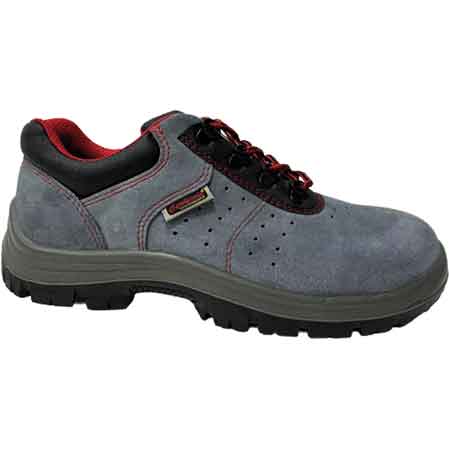
In short: the codes on safety shoes (standard EN ISO 20345) tell you what they protect you from: all have the 200 J toe cap; S1 adds antistatic properties and heel energy absorption (dry environments), S1P adds the puncture-resistant midsole (workshops, warehouses), S3 also adds a water-repellent upper and a cleated sole (construction sites and outdoors). Choose the class based on the risk first, then materials and comfort.
You walk into a shop or open an online collection and find hundreds of models: low-cut, high-cut, “summer”, sporty, with codes like S1P SRC or S3 WR. If you choose by colour, you risk twice over: buying a shoe that does not protect against the real risks of your job, or paying for protections you do not need that weigh on your feet eight hours a day.
In this guide we bring order: what the S1, S1P, S2 and S3 classes mean, which one to choose for each type of work (or demanding DIY) and what to look at in the toe cap, midsole and sole. You will find all the models — low, high, winter and summer — in the safety shoes collection.
What the standard says: EN ISO 20345 in plain words
All safety footwear sold in Europe complies with the EN ISO 20345 standard. The basic requirement, common to every class, is the protective toe cap resistant to a 200 joule impact and a 15 kN compression: in practice, a heavy object falling or a trolley running over your foot. Starting from this base, each code adds protections:
- SB — the basic requirement: toe cap only. Now rare in professional use.
- S1 — SB + antistatic properties, heel energy absorption, closed heel area and fuel-oil-resistant sole.
- S1P — S1 + puncture-resistant midsole (nails, screws, shavings on the ground).
- S2 — S1 + upper resistant to water penetration and absorption (damp environments, frequent washing).
- S3 — S2 + puncture-resistant midsole + cleated sole: the “complete” shoe for construction sites and outdoors.
- S4 / S5 — the equivalents of S1 and S3 as a waterproof polymer boot (agriculture, food industry, construction with mud and water).
On the labels you will also find additional markings: SR/SRC for slip resistance, WR (waterproof footwear), CI/HI (cold/heat insulation), ESD (electrostatic dissipation for electronics), HRO (sole resistant to contact heat). The update to the standard (EN ISO 20345:2022) also introduced classes S6 and S7 — essentially S2 and S3 with built-in WR waterproofing — which you will see more and more often on new models.
The table: which class for which job
| Class | Key protections | Ideal for |
|---|---|---|
| S1 | 200 J toe cap, antistatic, cushioned heel | Dry indoor environments: light logistics, assembly, crafts |
| S1P | S1 + puncture-resistant midsole | Workshops, warehouses, fitters, joineries: where nails and shavings lie on the ground |
| S2 | S1 + water-repellent upper | Food industry, kitchens, healthcare, frequent washing |
| S3 | S2 + midsole + cleated sole | Construction sites, outdoors, agriculture, heavy DIY |
| S5 | Waterproof boot + midsole + cleated sole | Mud, water, concrete pours, livestock farming |
If you are an employee, remember that the minimum class is set by your company's risk assessment document (safety footwear is PPE in every respect): the shoe you buy must comply with at least that. For DIY, common sense applies: to assemble furniture an S1 is enough; to demolish a bathroom or work in the garden with heavy tools, think like a construction site and go for S3. If you are about to tile a bathroom or install a pump in the garden, your feet will thank you.
Toe cap, midsole, sole: materials matter
Toe cap: steel, aluminium or composite?
The protection is identical (200 J for all); what changes is everything around it:
- Steel: cheap and slim, but heavy and it conducts cold and heat;
- Aluminium: lighter than steel, slightly bulkier;
- Composite/fibreglass: the lightest, athermic and metal free (handy if you pass through metal detectors, e.g. airports and sensitive sites). It costs a little more.
Puncture-resistant midsole: steel or textile?
The steel midsole resists well but stiffens the sole and covers a little less surface area; the textile puncture-resistant one (high-tenacity fibres) covers the whole footbed, is flexible and light. On modern mid- and high-range shoes, textile is now the standard.
Sole and grip
Dual-density polyurethane for lightness and everyday comfort, nitrile rubber where heat resistance and superior grip are needed. Check the anti-slip marking and, if you work on wet or ceramic surfaces, do not compromise on the tread pattern.
Comfort: the protection you actually wear
A protective but uncomfortable shoe ends up in the cupboard, and that is where accidents happen. Three practical rules:
- Try the size on in the afternoon (feet swell during the day) and with your work socks: the toe cap does not mould like a normal shoe, you need almost a centimetre free in front of your toes.
- Weight and breathability: for summer or hot environments there are “summer” S1P models with a mesh upper and composite toe cap that weigh as little as a running shoe; for winter and outdoors, better high-cut S3, water-repellent and lined.
- Insole and fit: if you spend eight hours on your feet, a replaceable anatomical insole and a wide fit across the metatarsal make more difference than the brand.
WHEN TO REPLACE THEM: safety shoes are not eternal. Replace them if the toe cap has taken a significant impact (even without visible damage the protection may be compromised), if the sole is worn to the point of losing its tread, or if the upper or seams are torn. With intensive daily use, the real average life is 6-12 months.
The most common buying mistakes (and how to avoid them)
- Buying your usual size sight unseen. With a toe cap and midsole, the fit changes from brand to brand: if you order online, check the manufacturer's size chart and the notes on fit (many models run half a size small).
- Choosing the highest class “to be safe”. A winter S3 worn in a heated warehouse means boiling feet and end-of-shift fatigue: the right protection is the one proportionate to the risk, not the maximum.
- Ignoring the weight. Between a 450 g shoe and a 700 g one there are, over a working day, tonnes of extra weight lifted by your legs. If you walk a lot, weight is a safety criterion, not laziness.
- Looking only at the price. Cheap safety shoes comply with the standard at the time of sale, but soles and seams age sooner: if you use them every day, the cost per month of real life often rewards the mid-range.
- Not pairing the right socks. Technical work socks (reinforcements, breathable fibres) improve comfort and hygiene as much as a good insole: it is the most underrated accessory.
FAQ: frequently asked questions about safety shoes
What is the difference between S1 and S1P?
Only the puncture-resistant midsole: the S1P also protects against nails and sharp objects on the ground. For the same model it weighs and costs a little more: if in doubt, choose S1P.
When do you need S3 instead of S1P?
When you work outdoors or on wet, muddy surfaces: the S3 adds a water-repellent upper and a cleated sole. On construction sites the S3 is de facto the required standard.
Are there lightweight summer safety shoes?
Yes: S1 and S1P models with a breathable mesh upper, composite toe cap and textile midsole come in under 500 grams per shoe. For summer outdoor work there are also lightweight S3 with breathable membranes.
What does the SRC (or SR) marking mean?
It indicates slip resistance tested on different surfaces: SRC was the top level of the old standard (tested on ceramic and steel); the 2022 revision replaced it with the SR requirement. In practice: the higher the marking, the better the grip on wet surfaces.
Are safety shoes mandatory for DIY?
At home nobody forces you, but the risks of heavy work are the same as on a construction site: a falling hammer or a stepped-on screw does not distinguish the professional from the hobbyist. For demolition, heavy gardening and house moves, an S1P or S3 is a small, one-off expense.
In conclusion
To choose the right safety shoes, the path is: first the class (S1 for dry indoors, S1P for workshop and warehouse, S3 for construction sites and outdoors), then the materials (composite toe cap and textile midsole if you want lightness), finally the comfort, which decides whether you will actually wear them. In the safety shoes collection you will find hundreds of models filterable by class and season, with fast shipping and instalment payment options.
Related guides for your jobs around the house: how to tile a bathroom · installing wall-hung bathroom furniture · self-priming pump: the guide.


