

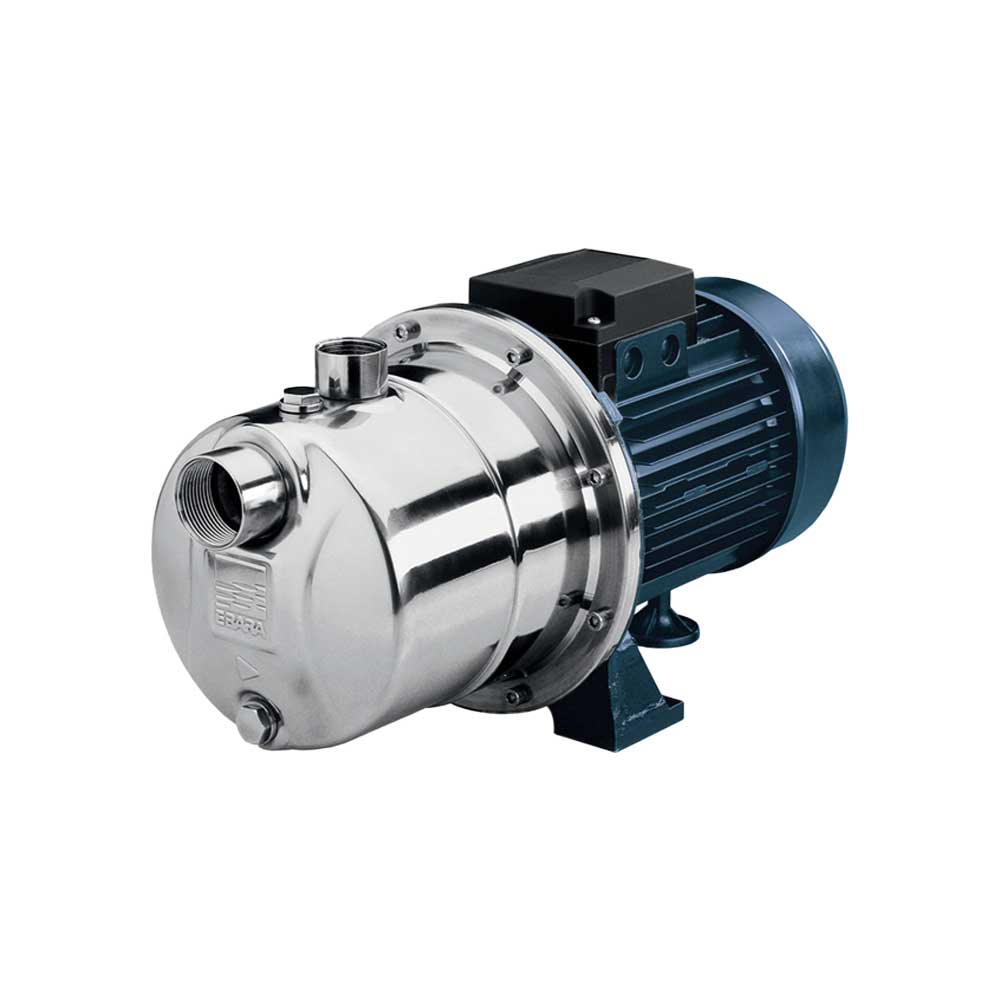
In short: a self-priming pump is a surface pump that can expel the air from the suction pipe on its own and draw water from a depth of up to about 8 metres. You choose it based on flow rate (how much water you need) and head (at what height and pressure): for home and garden use, models from 0.5 to 1.5 HP are usually enough.
Do you have a rainwater harvesting tank, a shallow well or a storage tank in the garden, and every time you need to water you end up hauling buckets and a watering can? Or has your old pump given up, and you are not sure whether the right replacement is a “self-priming” pump, a centrifugal one or a submersible one?
In this guide we look at how a self-priming pump works, when it is the right choice and how to size it with just two numbers: flow rate and head. At the end you will find a practical table for the most common use cases and a worked, step-by-step sizing example.
What a self-priming pump is and how it works
A traditional centrifugal pump moves water well, but it has one limitation: it cannot handle air. If there is air in the suction pipe — and at the first start-up there always is — the impeller just “spins dry” without managing to draw the water up.
The self-priming pump solves exactly this problem: thanks to an internal recirculation circuit (in garden models it is almost always a jet system with a Venturi ejector), the pump mixes the water inside the pump body with the air in the suction pipe, expels it a little at a time and creates the vacuum needed to draw the water up by itself, even from a level lower than where the pump is installed.
In practice: you fill the pump body with water once, at the very first start-up (this operation is called priming), and from then on the pump takes care of itself, even if some air gets back into the pipe.
The physical limit: around 8 metres of suction lift
No surface pump, however powerful, can lift water from more than 9-10 metres: it is a physical limit set by atmospheric pressure. In practice, consider 7-8 metres as the maximum suction depth for a self-priming pump. If your water is deeper than that (drilled boreholes), the right way to go is a submersible pump: we cover it in our dedicated guide to well pumps.
On our store you will find a complete selection of self-priming pumps and pressure booster sets by Ebara and Grundfos, in cast iron and stainless steel, with fast shipping.
Self-priming, centrifugal or submersible: which one you actually need
Before looking at power ratings and prices, ask yourself where you are drawing the water from:
- Water below pump level, within 7-8 m (underground cistern, shallow well, ground-level tank): self-priming. This is its home turf.
- Water at pump level or above (raised tank, boosting from the mains): a non-self-priming centrifugal pump is enough — quieter and more efficient for the same power.
- Water deeper than 8 m (drilled borehole): a 4" or 5" submersible pump, which pushes the water instead of sucking it.
- Dirty water to be drained (flooded basement, pool bottom): a submersible drainage pump with a float switch, not a self-priming pump (debris would damage the ejector).
How to choose: flow rate, head and materials
Two numbers describe any pump. Learning them protects you from the most common mistake: buying “by horsepower” instead of by the job to be done.
Work out the flow rate (Q) you need
Flow rate is the amount of water moved over time, expressed in litres per minute (l/min) or cubic metres per hour (m³/h). Add up the outlets you will use at the same time: a garden sprinkler takes 10-15 l/min on average, a tap 8-10 l/min. Two sprinklers running together = around 24-30 l/min, i.e. 1.5-1.8 m³/h.
Work out the head (H) you need
Head is the energy the pump gives the water, expressed in metres of water column. Golden rule: 1 bar of pressure = 10 metres of head. You calculate it by adding up:
- the suction lift (from the water surface to the pump);
- the discharge lift (from the pump to the highest point of use);
- the pressure you want at the point of use (e.g. 2.5 bar for a sprinkler = 25 m);
- the friction losses of pipes and fittings (in a simple domestic system, add 10-15%).
Watch out for the spec-sheet trick: the maximum head declared applies at zero flow. Always look at the pump curve and check that at YOUR flow rate the head is still sufficient.
Cast iron or stainless steel?
A cast iron pump body is sturdy and affordable, perfect for irrigation and occasional use. AISI 304 stainless steel resists corrosion better and is the recommended choice for domestic water supply, slightly aggressive water or installation in damp locations. For the vegetable garden a cast iron jet pump is perfectly fine; to supply the house, go for stainless steel.
Quick sizing table
| Use case | Indicative flow rate | Indicative head | Typical power |
|---|---|---|---|
| Small vegetable patch/garden (1 sprinkler or spray gun) | 10-15 l/min | 25-30 m | 0.5-0.75 HP |
| Medium garden (2-3 sprinklers together) | 25-40 l/min | 30-40 m | 1 HP |
| Single-storey house with pressure tank (2-4 people) | 30-40 l/min | 35-45 m | 1 HP |
| Two-storey house or multiple outlets | 40-60 l/min | 45-55 m | 1.5 HP |
Indicative values for quality single-phase self-priming pumps: always check the flow/head curve of the specific model.
Worked example: watering a 300 m² garden
Scenario: underground cistern with the water surface 1.5 m below the pump, 2 sprinklers at 12 l/min running together at 2.5 bar, highest watering point at +1 m.
- Flow rate: 2 × 12 l/min = 24 l/min ≈ 1.4 m³/h.
- Head: 1.5 m (suction) + 1 m (discharge) + 25 m (2.5 bar at the sprinklers) = 27.5 m; add 10% friction losses → about 30 m.
- Choice: you need a self-priming pump that still delivers at least 30 m of head at 1.4 m³/h: in practice a 0.75-1 HP jet pump, such as the Ebara AGA/E models in cast iron or JESXM/E in stainless steel.
If rainwater with leaves or sand flows into the cistern, fit a foot valve with a strainer on the suction pipe: it protects the impeller and keeps the pipe full, so the pump restarts instantly.
Installation: mistakes to avoid
- Never let it run dry: the mechanical seal is cooled by the water being pumped; a few minutes running dry are enough to burn it out. If the source can run empty, add a dry-running protection device.
- Keep the suction pipe short and rising steadily towards the pump, with no counter-slopes where air pockets can form.
- Never use a suction pipe smaller than the pump inlet: choking the suction is the number one cause of failed priming.
- Protect it from frost: in winter, drain the pump body and pipework, or install it in a sheltered room.
ELECTRICAL SAFETY: the pump works with water and electricity together. Always connect it to a line protected by a 30 mA residual current device (RCD), use outdoor-rated sockets and cables (IP44 or higher) and never touch the pump with wet hands or while standing in water. For a fixed connection to the electrical system, call a qualified electrician.
FAQ: frequently asked questions about self-priming pumps
From what depth can a self-priming pump draw water?
Up to about 8 metres measured from the water surface to the pump inlet. It is a physical limit that applies to any surface pump: beyond that you need a submersible pump.
What is the difference between a self-priming pump and a submersible pump?
The self-priming pump sits outside the water and sucks it from above (max 8 m); the submersible pump works underwater and pushes the water upwards, even from 50 metres and more. The first is easier to install and maintain, the second is a must for deep wells.
Why won't my self-priming pump prime?
The most common causes: pump body not filled with water at first start-up, air leaks in the suction pipe (fittings not airtight), foot valve stuck or missing, suction lift greater than 8 metres, suction choked by a pipe that is too narrow.
Do I always need a foot valve?
It is not mandatory (the pump is self-priming precisely for this reason), but it is strongly recommended: it keeps the pipe full of water, speeds up restarts, reduces wear and, with its built-in strainer, blocks sand and debris.
How much power do I need to water the garden?
For a domestic garden with 1-3 sprinklers, 0.5-1 HP is enough. Flow rate and head at the duty point matter more than power: check the pump curve before the horsepower label.
Can I use it to boost the water pressure in my house?
Yes: paired with a diaphragm pressure tank and a pressure switch it becomes a domestic pressure booster system. In that case choose a stainless steel model suitable for domestic water.
In conclusion
To choose a self-priming pump well, three steps are enough: check that the water is within 8 metres, work out the flow rate and head of your real case, and pick the material based on the use. You will find all the models mentioned in the pumps and pressure booster sets collection, with instalment payment options and fast shipping.
You might also like these guides: if you have a pool in the garden, read our overview of outdoor garden pools; if the water pressure in your house is playing up starting from the bathroom fittings, start with how to fix a dripping tap; and if the water you pump is very hard, find out how to remove limescale from the shower.


