

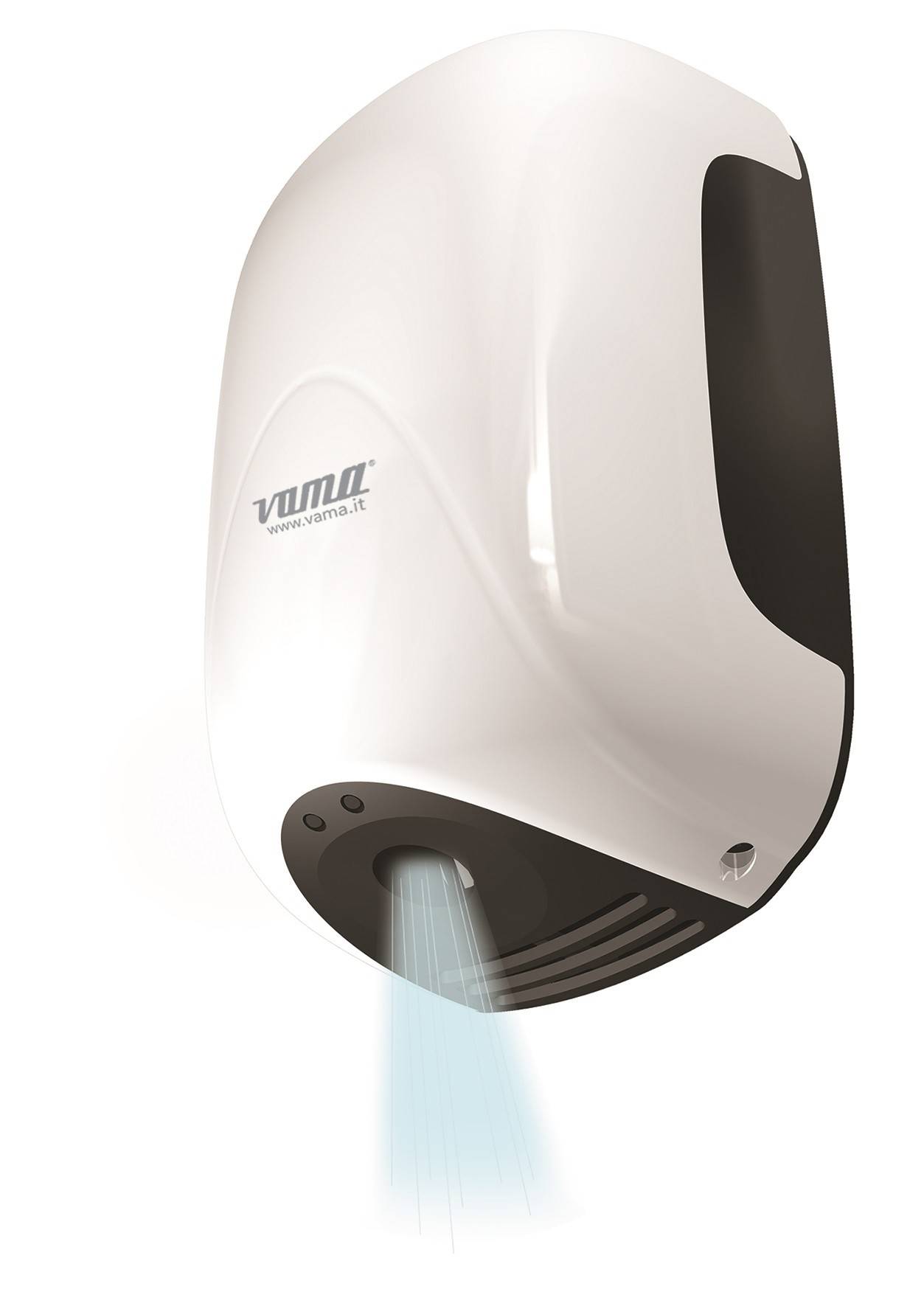
In short: a traditional wall-mounted hand dryer (2,000-2,500 W for 30-40 seconds) uses about 0.02-0.03 kWh per dry, a high-speed one (900-1,400 W for 10-15 seconds) even less than 0.005 kWh: fractions of a cent per use. For busy bathrooms it is cheaper and more hygienic than paper; the choice comes down to power, sensor operation, noise level and sturdiness.
You run a bar, a B&B, an office with a customer bathroom — or you are simply tired of buying pallets of paper towels — and you are wondering whether a wall-mounted hand dryer is really worth it: how much does it weigh on the electricity bill? Is it noisy? Push-button or sensor?
In this guide we answer with numbers: how much a wall-mounted hand dryer consumes, what a single dry costs, the comparison with paper and the criteria for choosing the right model for your bathroom. You will find all the models, from the compact one for a B&B to the professional high-speed unit, in the collection of wall-mounted hand dryers.
The two families: traditional warm air and high speed
Traditional warm-air dryers
The classic: a heating element warms the air and a fan blows it onto your hands. Typical power ratings of 1,800-2,500 W, drying time of 30-45 seconds. Pros: low price, relative quietness, simplicity (very few failures). Cons: longer times, therefore higher consumption per use and queues in crowded bathrooms.
High-speed (jet) dryers
Here the work is done not by heat but by air: a high-performance motor drives a jet that “sweeps” the water off your hands in 10-15 seconds, with power ratings between 900 and 1,400 W (often with a reduced or no heating element). Pros: extremely fast, much lower consumption per use, ideal for high traffic. Cons: noisier and more expensive to buy.
Push-button or sensor?
Sensor operation (hands under the airflow activate the jet) is today's recommended standard: no contact — therefore more hygienic — and the unit runs only for the actual time of use. The push-button with timer survives on the cheapest models: simple, but every press consumes a full cycle even if you walk away early.
How much it really consumes: the calculation
The consumption of a cycle is calculated like this: power (kW) × duration (hours). With an energy price of €0.25/kWh:
| Type | Power | Cycle duration | Consumption/cycle | Cost per 100 dries |
|---|---|---|---|---|
| Traditional, push-button | 2,400 W | 40 s | ~0.027 kWh | ~€0.67 |
| Traditional, sensor | 2,000 W | 30 s | ~0.017 kWh | ~€0.42 |
| High speed (jet) | 1,100 W | 12 s | ~0.004 kWh | ~€0.09 |
| Paper towels (2 sheets) | — | — | — | €2-4 (+ waste disposal) |
Indicative values at €0.25/kWh; paper estimated at 1-2 cents per sheet. With your own utility rates, the ratio between the options does not change.
The message of the table is clear: even the most power-hungry model costs less than a cent per dry, and in a busy bathroom the electric dryer beats paper by an order of magnitude, also eliminating dispensers to refill and bins to empty. The “real” consumption to watch is not the wattage on the nameplate but how long the cycle lasts: that is why a 1,100 W jet consumes less than a 2,400 W traditional unit.
How to choose the right model for your bathroom
For the home and the B&B
In a domestic setting, the electric hand dryer makes sense in the guest or service bathroom: choose a compact traditional model with a sensor (1,000-1,800 W), quiet and discreet. At home, for the main bathrooms, the fabric towel remains the natural choice — perhaps warmed: if you like the idea, read the guide on how to choose an electric towel warmer.
For bars, restaurants and offices
Medium traffic, customers not to be kept waiting: a 1,800-2,000 W sensor-operated traditional dryer or a mid-range jet are the balance point between price, noise and speed. Watch the noise level if the bathroom borders the dining room: below 70 dB life is good.
For shopping centres, gyms, motorway services
High traffic = high speed, no discussion: 10-12 second cycles, minimal consumption per use, vandal-proof casings in steel or die-cast aluminium. Here the sturdiness of the fixings and ease of cleaning matter too.
The details that make the difference
- IP protection rating: in a bathroom the unit must have an IP rating adequate for splashes (IP23 or higher depending on the installation position);
- Casing: ABS for economy and lightness, stainless steel or aluminium for durability and heavy use;
- Adjustable or removable heating element: some models let you switch off the heating in summer, halving consumption;
- Spare parts availability: for a public venue it is the difference between a repair and a replacement.
Wall installation: heights and electrical safety
The recommended installation heights (measured from the floor to the bottom edge of the unit) are roughly 115-125 cm for adults, 95-105 cm if the bathroom is used by children, about 85-90 cm for wheelchair accessibility. Fix the unit to a solid wall or with anchors adequate for the weight: a steel jet dryer easily exceeds 5 kg.
ELECTRICAL SAFETY: the hand dryer must be installed outside the safety zones of showers and washbasins defined by the wiring regulations (IEC 60364 and your local rules), on a line protected by a 30 mA RCD. Many models require a fixed connection rather than a plug: in that case the hook-up is a job for a qualified electrician. Never install it where it can be hit by direct water jets.
Maintenance: little, but done
A well-chosen hand dryer works for years with almost no attention. The three operations that extend its life:
- Weekly external cleaning (in public venues) with a neutral detergent: casing, nozzle and above all the sensor window, which, when dirty with limescale and dust, can cause missed activations or, on the contrary, continuous running.
- Air filter: many high-speed models have a removable filter that traps dust and lint; check it every 1-3 months. A clogged filter lengthens drying times and strains the motor.
- Check the fixings once a year: on powerful models the motor's vibrations can loosen the anchors over time.
If the unit stops heating but the fan runs, the heating element is the first suspect: on branded models it is an orderable spare part, one more reason to choose manufacturers with spare parts available.
FAQ: frequently asked questions about wall-mounted hand dryers
How much does a hand dryer consume in a month?
It depends only on the number of uses: a bar with 100 dries a day spends roughly 12-20 euros a month with a traditional model and 2-4 euros with a high-speed jet. At home, with a few uses a day, the consumption is negligible.
Is an electric hand dryer better than paper?
On costs, the electric dryer wins as soon as traffic rises: no refills, no waste, a cost per use up to 20-30 times lower. Paper remains sensible only where uses are very few or where it is needed for other purposes too.
Do sensor-operated dryers break easily?
No, quite the opposite: without a mechanical button there is one less wear-prone component. The sensor just needs to be kept clean of dust and limescale to avoid missed activations.
How noisy is a high-speed hand dryer?
Jets generally declare 70-80 dB in operation, traditional models 55-70 dB. For a small venue with the bathroom close to the tables, a sensor-operated traditional dryer or a jet with an adjustable motor is the more prudent choice.
Can I install it myself?
The wall fixing yes, if you are handy with a drill and anchors. The electrical connection depends on the model: with a plug it is immediate; with a fixed connection to the line you need a qualified electrician, also for the declaration of conformity.
In conclusion
The wall-mounted hand dryer is one of those choices that pay for themselves: minimal consumption per use, no paper to keep buying and a tidier bathroom. Choose the sensor-operated traditional model for the home, B&Bs and quiet venues, high speed where the flow of people is continuous, and always check the IP rating, noise level and type of connection. Compare the models in the hand dryers collection: fast shipping and instalment payment options.
Related guides: electric towel warmer: how to choose it · preventing mould in the bathroom · coordinated bathroom accessory sets.


