

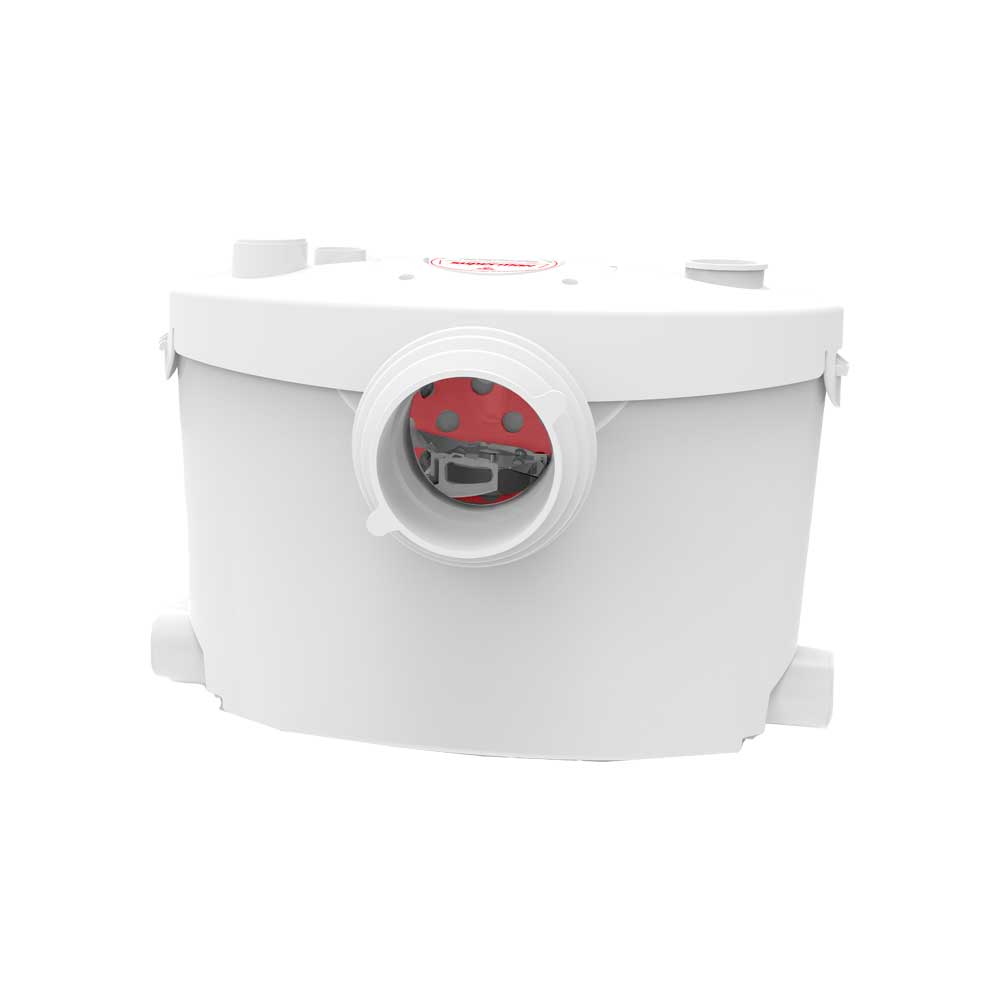
In short: a WC macerator is a pump with blades that shreds the toilet waste and pushes it through a small-diameter pipe (20-40 mm instead of the 100 mm of a traditional drain), even upwards and over long distances. In practice it lets you create a bathroom where a gravity drain cannot reach: basement, loft, garage, under the stairs, an extra en-suite bedroom.
There is a room in the basement that would make the perfect guest bedroom, if only it had a bathroom. Or you would like a second WC in the loft, in the laundry room, next to the study. And every time the plumber's answer is the same: “The drain is too far away, we would have to break everything open”. That is exactly the problem the WC macerator was born to solve.
In this guide we look at how a macerator works, where it really lets you create a new bathroom without demolition, what its limits are and how to choose the right model. You will find the available Techno macerators in the WC macerators collection.
How a WC macerator works
A traditional drain works by gravity: the waste flows down a 100-110 mm pipe with a constant minimum slope to the soil stack. If the new bathroom is lower than the stack, too far away, or has no sloping route, gravity is not enough — and that is where the macerator comes in.
The macerator is a compact box installed behind or next to the toilet (toilets with a built-in macerator also exist). When you flush, three things happen in sequence:
- a level sensor detects the incoming water and starts the motor;
- a system of rotating blades shreds toilet paper and waste in a few seconds until they can be pumped;
- a pump pushes everything through a small-diameter discharge pipe (generally 20 to 40 mm) to the existing soil stack.
Its strong point is precisely the pressurised discharge: unlike gravity, the pump can push upwards for several metres and horizontally for tens of metres (the exact values depend on the model: always check the data sheet, and remember that every vertical metre “uses up” many metres of horizontal push).
Where the macerator lets you create a new bathroom
- Basement, cellar and rooms below drain level: the classic case. The pump lifts the waste up to the stack, which is impossible by gravity.
- Loft and attic: when the soil stack is far away and there is no way to create slopes in the screed.
- Garage, laundry room, hobby room: a service WC with a washbasin, without touching the existing system.
- An extra en-suite bedroom: the walk-in wardrobe or box room that becomes a master bathroom, running the 32 mm pipe inside a plasterboard wall or behind a service skirting.
- Renovations without demolition: in flats where breaking up the floor is not possible (or not worth it), the macerator avoids redoing the drains.
Note: works that involve a new bathroom are subject to your local building and sanitary regulations (ventilation, minimum heights, works notifications). The macerator solves the plumbing problem, not the paperwork: that is why you should always consult a professional.
The models available: how many fixtures you can connect
The first question to ask yourself is: will the macerator serve only the WC or the whole bathroom? Models differ by the number of inlets, i.e. how many fixtures can discharge into them (washbasin, shower, bidet in addition to the toilet). These are the Techno macerators you will find on our store:
| Model | Inlets | Ideal for |
|---|---|---|
| Techno Saniplast | 3 | WC + washbasin + bidet: the complete service bathroom |
| Techno Shower Tech | 2 | Compact layouts with a shower, e.g. WC + shower tray |
| Techno Supermax | 4 | Full bathroom: WC + washbasin + bidet + shower |
| Techno Politech Wall | 4 | Full bathroom with wall/built-in installation for wall-hung toilets |
Head (vertical metres) and maximum horizontal distance vary from model to model: compare the data sheet with the real route of your pipe before buying.
Two design tips: if you connect a shower, the tray must sit a few centimetres higher than the macerator inlet (the water must reach it by gravity: consider a raised tray or a platform); and every connected fixture must have its own trap.
Limits and rules of use: what the macerator does not forgive
The macerator is reliable if you treat it for what it is: a pump with blades, not an incinerator. The rules are few and absolute:
- Only toilet paper and waste in the WC. “Biodegradable” wipes, sanitary towels, cotton wool, cat litter and rags are the number one cause of blockages.
- No solvents, strong acids or chemical drain uncloggers: they damage seals and components. For cleaning, use specific macerator cleaners or gentle products.
- It needs electricity: without power the WC does not flush. Keep this in mind in areas with frequent blackouts.
- Noise: modern models run for a few seconds per flush at a level comparable to a household appliance; if the bathroom borders a bedroom, look at models declared as soundproofed.
- Maintenance: a cleaning cycle with a specific descaling product every 3-6 months (more often with hard water) keeps the blades and the sensor efficient.
SAFETY: before any work on the macerator — even just removing a blockage — unplug it. The blades are designed to restart on their own when the level rises: never put your hands inside the box while the unit is powered. Connect it to a line protected by a 30 mA RCD, like every electrical appliance in the bathroom.
Installation: what to plan for (and when to call the plumber)
Compared with a traditional bathroom, the installation is much lighter, but there are a few fixed points:
- Toilet with horizontal outlet: the external macerator connects to a normal WC with a wall outlet; measure the space behind the pan.
- Route of the discharge pipe: vertical first (right after the unit), then horizontal with a slight slope; wide bends, not tight elbows. Fit a non-return valve if not built in.
- Venting: the macerator must be able to “breathe” as per the manufacturer's instructions.
- A dedicated, compliant power socket, outside the safety zones of the shower and bathtub.
An experienced plumber fits a macerator in half a day. If the toilet to pair with it is new, in the guide to installing a WC you will find the steps for fitting the pan.
Common macerator problems: symptoms and causes
If the macerator shows signs of trouble, the symptom almost always points to the cause:
- It starts continuously even with no flushing: usually the non-return valve is not sealing (water flows back and re-triggers the level sensor) or an inlet is dripping, for example a leaking WC cistern.
- Metallic noise or strong vibrations: a hard object has got between the blades. Disconnect the power and remove it following the manual: continuing to use it like this damages blades and motor.
- Slow discharge or motor running without emptying: impeller or discharge line partially blocked by limescale: it is the sign that the cleaning cycle with a specific descaler is overdue.
- Smells in the bathroom: check the traps of the connected fixtures and the vent: the unit itself is almost never to blame.
- It does not start at all: in order, check the power supply and the RCD, then the motor's thermal protection (recent models stop when overheated and restart when cool).
The rule that always applies: any check is done with the plug pulled out, and if the problem persists, the manufacturer's service centre comes before ambitious DIY.
FAQ: frequently asked questions about WC macerators
Does a WC macerator get blocked often?
No, if only toilet paper and waste go into it. Almost all blockages are caused by items that should never be thrown into the toilet: wipes, sanitary towels, cotton wool. With correct use and periodic cleaning it is a long-lived appliance.
How noisy is a macerator?
Current models run for a few seconds per flush, with a noise comparable to a kitchen appliance. Installation (anti-vibration mounts, correct fixings) and the quality of the model also count.
Can I also connect a shower and washbasin to the macerator?
Yes, by choosing a model with more inlets (2, 3 or 4 depending on the bathroom layout) and respecting the levels: the shower must sit slightly raised so that the water reaches the unit by gravity.
How far can a macerator push the discharge?
Indicatively several metres vertically and several tens of metres horizontally, but the figure belongs to the individual model and the two measurements combine: the higher you go, the shorter the distance. Compare the manufacturer's curve with your real route.
What happens if the power goes out?
The macerator does not pump and the WC must not be used until the electricity returns. The box holds the residual content without spills, but it is good practice not to flush during a blackout.
In conclusion
The WC macerator turns the question “where does the drain run?” into “where can a 32-millimetre pipe run?” — and with that it opens up possibilities that once required demolition: the bathroom in the basement, the WC in the loft, the self-contained guest room. Choose the model based on the fixtures to connect and the route of the discharge, respect the few rules of use and you will have a new bathroom with a minimal worksite. You will find the Techno models mentioned in the WC macerators collection, with fast shipping and instalment payment options.
Related guides: installing a WC: the guide · how to unblock the toilet · how to choose the perfect shower enclosure.


