

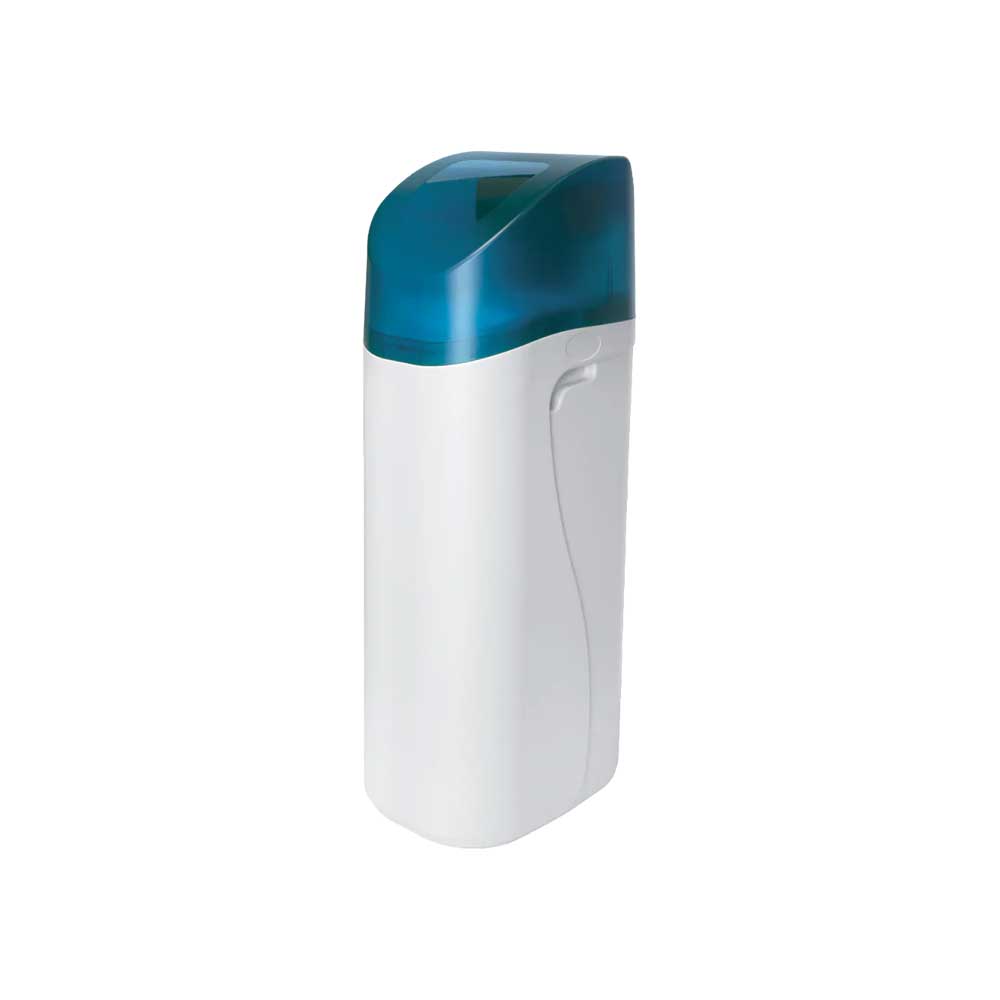
In short: a water softener reduces the hardness of your home's water, i.e. the calcium and magnesium content that forms limescale. The salt-based domestic type exchanges these minerals for sodium through resins and protects the boiler, appliances and taps. It is really worth it when hardness exceeds 25-30 °f (250-300 ppm); below 15-20 °f (150-200 ppm) it is generally not worth the expense.
You clean the shower enclosure and after three days the glass is cloudy again. The shower head sprays sideways, the washing machine demands salt like a ship, and at every service the boiler technician repeats the same word: limescale. If this sounds familiar, the question is legitimate: would a water softener solve everything? And above all, is it really worth it?
In this guide we look at what a home water softener does, how the salt-based type works, above which water hardness the investment pays for itself and when you can do without it instead. You will find systems, filters and spare parts in the water treatment collection, with solutions for every size of home.
What a water softener does
“Hard” water is rich in calcium and magnesium salts. It is not a health problem — on the contrary, they are useful minerals — but it is one for the house: when the water is heated or evaporates, those salts precipitate and become limescale. The softener works upstream, on the incoming water, and “softens” it before it reaches the boiler, pipework and taps.
In practice, a well-adjusted softener serves to:
- protect the boiler and heat exchanger: a few millimetres of limescale on the exchanger act as an insulator and force the boiler to consume more to heat the same water, as well as shortening its life;
- extend the life of the washing machine and dishwasher, whose heating elements are the first victims of hard water;
- drastically reduce anti-limescale cleaning on the shower enclosure, taps and sanitaryware;
- make detergents and soaps go further: with soft water you need less for the same result, and laundry and hair stay softer.
How the salt-based softener works (ion exchange)
The heart of the domestic softener is a cylinder full of ion exchange resins: microbeads that hold back the calcium and magnesium ions in the passing water and release sodium ions in exchange, which do not form deposits.
The resins, however, become “saturated”: after treating a certain amount of water, they must be regenerated. The softener does it by itself, at night, washing them with water and salt tablets taken from its tank: the salt strips calcium and magnesium off the resins and sends them down the drain, and the cycle starts again. Your only job is to top up the salt every 1-2 months.
The bypass valve and the hardness blending valve
Every correct installation includes a bypass (to exclude the softener during maintenance without being left without water) and a blending valve that regulates the outgoing hardness. Water should not be softened to zero: a residual hardness of about 15 °f (150 ppm) protects the pipework and keeps drinking water tasting good.
When it is really worth it: look at your water hardness
Hardness is commonly measured in French degrees (°f) — 1 °f equals 10 ppm of calcium carbonate. You can find out your home's hardness in three ways: on your water utility's website (it is public data), with a drop or strip test costing a few tens of euros, or by asking the technician at the next boiler service.
| Water hardness | Classification | Is a softener worth it? |
|---|---|---|
| Up to 15 °f (150 ppm) | Soft water | No: the expense does not pay off |
| 15-25 °f (150-250 ppm) | Moderately hard | It depends: consider a scale filter for the boiler only |
| 25-35 °f (250-350 ppm) | Hard | Yes: clear benefits on bills and maintenance |
| Over 35 °f (350 ppm) | Very hard | Yes, strongly recommended |
Many limestone areas of Europe consistently exceed 30 °f: there, a softener is not a whim, it is preventive maintenance for the house.
When you can do without it
- Water below 15-20 °f: deposits are modest; a good anti-limescale routine is enough (see the guide on how to remove limescale from the shower).
- You only want to protect the boiler: a polyphosphate dosing filter fitted on the boiler inlet costs a fraction of a softener and prevents scale on the heat exchanger. It does not soften the whole house's water, but for the boiler problem it is often enough.
- A rarely used house (second home): the volumes of treated water do not justify the system and its maintenance.
The 5 signs that your water is too hard
Even before measuring, your house is already telling you. If you recognise at least three of these signs, measuring the hardness is almost a formality:
- Cloudy shower glass a few days after cleaning, with white streaks that always come back in the same spots;
- Shower head and tap aerators clogging up: crooked jets, reduced flow, and every few months you have to unscrew them and soak them in descaler;
- Heating elements white with deposits in the kettle and iron, and a washing machine demanding ever-larger doses of descaler;
- A boiler losing efficiency: longer waits for hot water, metallic noises from the exchanger, a technician recommending a chemical flush;
- Stiff laundry and skin that feels tight after the shower: calcium salts react with soaps and reduce their effectiveness.
Each of these problems has its local remedy — and on the blog we have covered almost all of them — but when they appear together it is time to stop treating the symptoms and treat the cause.
Which size to choose: sizing in two numbers
The size of a softener is expressed in litres of resin. Sizing depends on how many people live in the house and on the incoming hardness: the harder the water and the more of you there are, the more resin is needed to avoid regenerating too often.
- 1-2 people, medium hardness: 8-12 litres of resin (compact under-sink models exist);
- 3-4 people: 15-20 litres, the best-selling size for a family home;
- 5+ people or a house with a garden: 25-30 litres.
When in doubt, go one size up: a slightly oversized softener regenerates less often, uses less salt and lasts longer. Models with volume-based (metered) regeneration (they count the litres actually treated instead of regenerating on fixed days) are the most efficient for a family's real consumption.
Running costs and maintenance: what to expect
- Salt tablets: a family of 3-4 uses roughly 25-50 kg of salt every 2-3 months, depending on hardness and consumption. We are talking a few euros a month.
- Regeneration water: each cycle discharges a few dozen litres; with metered regeneration the impact on the bill is marginal.
- Maintenance: annual check of resins and valve, cleaning of the salt tank, and the sanitising tablet where provided. Regulations on drinking water treatment equipment require it to be maintained according to the manufacturer's instructions: keep the manual and respect the schedule.
- Electricity: the control unit uses about as much as a clock radio.
All added up, running costs are in the region of 50-100 euros a year: less than a single repair of a scaled-up boiler or the early replacement of a washing machine.
FAQ: frequently asked questions about water softeners
Can you drink softened water?
Yes, if the system is correctly installed and maintained and the residual hardness is set (not to zero). The softener adds a small amount of sodium: anyone on a strictly low-sodium diet can keep one untreated water tap for drinking and cooking.
How often does the salt need topping up?
On average every 1-2 months for a family: check the tank once a month and top up when the salt drops below a third. Use only salt tablets specifically for softeners.
Does the softener also remove the limescale already in the pipes?
Partly: softened water slowly tends to re-dissolve existing deposits, but the process takes months. Scale already formed on taps and sanitaryware must be removed by hand once; after that it does not come back.
Is a softener better than a magnetic scale filter?
They are different things: the softener physically removes calcium and magnesium with measurable effectiveness; magnetic/electronic devices claim to change how limescale crystallises, with very variable results. For genuinely hard water, ion exchange remains the standard.
Where is the softener installed?
Right after the water meter (or in any case upstream of the boiler), with a bypass, a drain for regeneration and a power socket nearby. Typical spots: utility room, garage, under the sink for compact models. Installation requires a plumber but is half a day's work.
In conclusion
The answer to “is a softener worth it?” lies in one number: the hardness of your water. Above 25-30 °f, between a protected boiler, longer-lived appliances and hours of cleaning saved, the system pays for itself; below 15-20 °f you can postpone and get by with good anti-limescale habits. In the water treatment collection you will find softeners, polyphosphate dosing filters and filters for every need, with fast shipping and instalment payment options.
Related guides: how to remove limescale from the shower · how to clean the shower head · domestic pressure booster system: how it works.


