

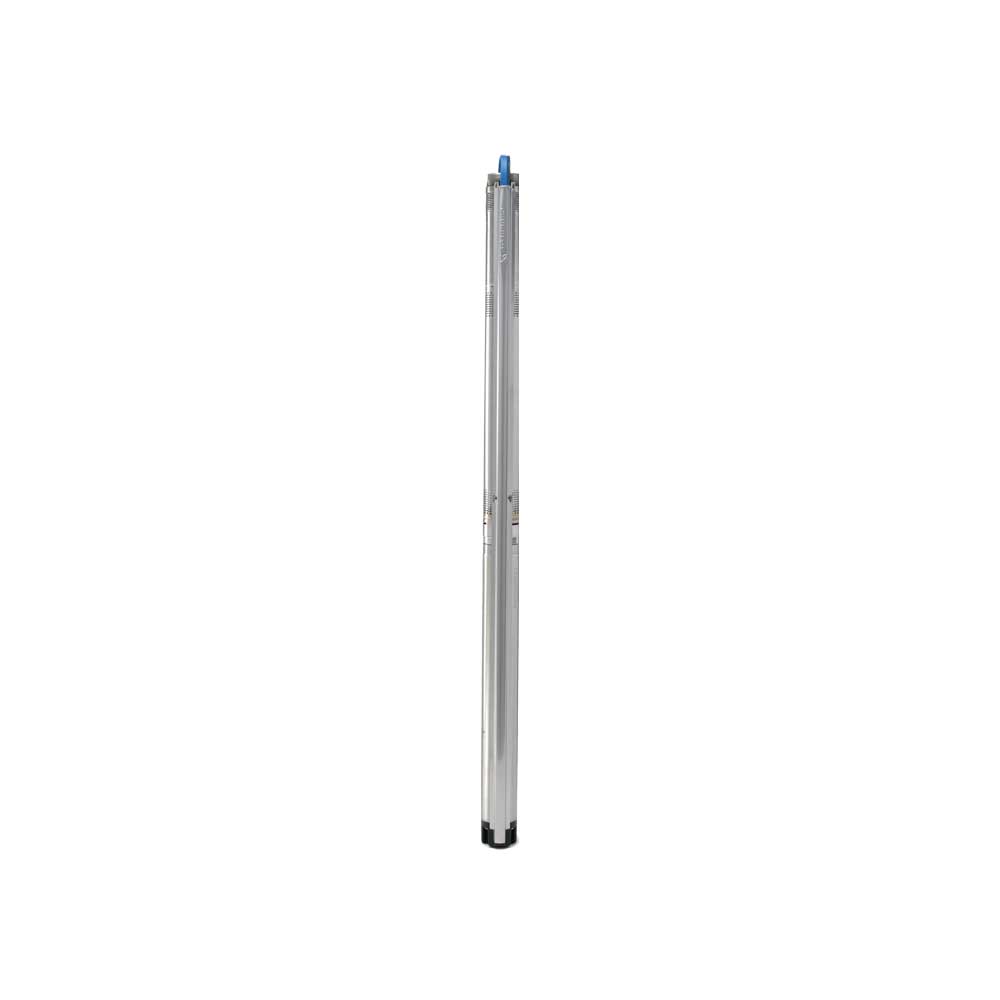
In short: if the water level in your well stays within 7-8 metres of the pump, you can use a surface self-priming pump; deeper than that you need a 4-inch or 5-inch submersible pump. To size it, add up the lift, the required pressure (1 bar = 10 metres) and the friction losses: that is the minimum head at the flow rate you need.
You have a well in the garden and want to use it for irrigation or to supply the house, but the catalogues have left you stuck: submersible or surface? 4 inches or 5? And above all: how many “metres of head” do you actually need?
The good news is that choosing a well pump follows a few clear rules. In this guide we cover them all: the 8-metre criterion, the flow and head calculation with a worked example, the sizing table and the accessories that extend the life of the pump.
The 8-metre rule: when a surface pump is enough
The decisive criterion is not the depth of the well, but the depth of the water relative to the point where you would install the pump:
- Water within 7-8 metres (dug wells on a shallow water table, cisterns): you can comfortably install a self-priming surface pump, outside the well. It costs less, can be inspected in a moment and can be replaced without any special equipment. We have dedicated a complete guide to how a self-priming pump works.
- Water deeper than 8 metres (drilled boreholes, deep aquifers): the only reliable solution is a submersible pump, which works underwater and pushes the water upwards instead of sucking it. It has no practical depth limit: multistage models easily exceed 50-100 metres of head.
Why 8 metres? It is the physical limit of suction: beyond that water column, atmospheric pressure can no longer “push” the water towards the pump, no matter how powerful the motor is.
In the well pumps and pressure booster sets collection you will find both families: 4" and 5" submersibles by Ebara and Grundfos, self-priming surface pumps, control boxes and accessories.
Static and dynamic level: the figure that changes everything
When the well is in operation, the water level drops compared to when it is at rest. The level at rest is called static, the one during pumping dynamic: the latter is the one you must use in your calculations. If you do not know it, ask whoever drilled the well or run a drawdown test; if no data is available, prudently add 3-5 metres to the static level.
How to size the pump: flow rate and head
Step 1 — Establish the flow rate (Q)
Add up the outlets that will run at the same time:
- irrigation: 10-15 l/min per sprinkler;
- house: 30-40 l/min peak for a family of 3-4 with 2 bathrooms;
- filling cisterns or pools: here time matters more than simultaneity (an 8 m³ above-ground garden pool fills in about 3 hours at 45 l/min).
Watch the well yield: the pump must never draw more water than the well can supply, otherwise it will run dry. The design flow rate is the lower of your demand and the well yield.
Step 2 — Calculate the total head (H)
Head is measured in metres of water column (1 bar = 10 metres) and is the sum of three items:
- geodetic lift: from the dynamic water level to the highest point of use;
- required operating pressure: 2.5-3 bar (25-30 m) for a domestic system with a pressure tank, 2-2.5 bar for irrigation;
- friction losses: friction in pipes, bends and fittings; for simple systems estimate 10% of the total, more if the pipework is long or narrow.
Step 3 — Check against the pump curve
Every pump has a flow/head curve: as the flow rate increases, the head drops. The right model is the one that still guarantees the calculated head at your design flow rate. Do not trust the “maximum head” on the box alone: it applies with the taps closed.
Quick orientation table
| Dynamic water level | Pump type | Typical use | Typical power |
|---|---|---|---|
| Up to 7-8 m | Self-priming surface pump | Irrigation, shallow water table, cisterns | 0.75-1.5 HP |
| 8-25 m | 5" monoblock or 4" submersible | Deep dug wells, irrigation + house | 0.8-1 HP |
| 25-50 m | 4" multistage submersible | Drilled boreholes, house supply | 1-1.5 HP |
| Over 50 m | 4" multistage submersible with multiple impellers | Deep aquifers, multiple outlets | 1.5-3 HP |
Indicative values for single-phase domestic use: always verify the model against its flow/head curve.
Worked example: a 30-metre drilled borehole
Scenario: drilled borehole 30 m deep, static level at 12 m, dynamic level at 18 m. The pump must supply a single-storey house via a pressure tank with cut-out pressure at 3 bar. Family of 4, 2 bathrooms.
- Design flow rate: domestic peak of 35 l/min ≈ 2.1 m³/h (the well yields 3 m³/h: fine).
- Head: 18 m (dynamic level) + 2 m (lift up to the pressure tank) + 30 m (3 bar of pressure) = 50 m; + 10% losses → about 55 m.
- Choice: you need a 4-inch submersible that guarantees at least 55 m at 2.1 m³/h: typically a 1-1.5 HP multistage model (e.g. Ebara Winner 4WN or Grundfos SQ series), lowered on a safety rope to at least 1 metre from the bottom and always 2-3 metres below the dynamic level.
The accessories that save the pump
- Dry-running protection (float switch, level probes or flow/pressure switch): lack of water is the number one killer of submersible pumps.
- Starter and protection control box: mandatory for submersibles with an external capacitor motor, it protects against overloads and surges.
- Non-return valve on the discharge line: it prevents the water column from falling back at every stop.
- Filter or cooling shroud in wells with fine sand: sand wears out impellers and seals.
- Pressure tank: it reduces motor starts and stabilises the pressure in the house.
SAFETY AND REGULATIONS: the electrical connection of a submersible pump (dedicated line, 30 mA RCD, protection control box) must be carried out by a qualified electrician: water and 230 V do not forgive improvisation. Also remember that in most countries private wells must be declared or authorised by the competent local authorities, with additional requirements for drinking water use: check that your well is fully compliant before connecting it to the house system.
One last practical warning: well water is often very hard. If you notice white deposits on sanitaryware and glass, take action with our guide on how to remove limescale from the shower and consider a water treatment system.
FAQ: frequently asked questions about well pumps
Is a submersible or a surface pump better for a well?
It depends on the water depth: within 7-8 metres a surface self-priming pump is perfectly fine (cheaper and easier to maintain); beyond that, a submersible is mandatory. All else being equal, the submersible is quieter and has no priming issues.
How do you calculate the head of a well pump?
Add the lift from the dynamic water level to the highest point of use, the desired operating pressure converted into metres (1 bar = 10 m) and about 10% friction losses. The result is the minimum head at your design flow rate.
What is the difference between a 4-inch and a 5-inch submersible pump?
The diameter: the 4" (about 10 cm) fits into narrow drilled boreholes and is the standard for deep aquifers; the 5" is typical of monoblock models for wide wells, cisterns and shallow water tables. Always check the internal diameter of the well casing.
At what depth should the submersible pump be installed?
Always at least 2-3 metres below the dynamic level, but at least 1 metre from the bottom to avoid sucking in sand and sediment. It must be supported by a safety rope, never hung from the electric cable or the delivery pipe.
Can I use well water in the house?
For irrigation and technical uses yes, provided the well is authorised. For drinking use you need a water analysis and often a filtration/treatment system; for the washing machine, toilet and shower, still consider hardness and iron content, which stain sanitaryware and scale up heating elements.
How much does a well pump consume?
A 1 HP domestic submersible draws about 0.75 kW: half an hour of operation a day costs just a few cents. Correct sizing (with a pressure tank reducing motor starts) affects consumption more than the nameplate power.
In conclusion
To choose a well pump, always start from the dynamic water level: within 8 metres a surface self-priming pump, beyond that a submersible; then size it on your real flow rate and head, and protect the investment with dry-running protection and a control box. You will find submersibles, self-priming pumps and accessories in the pumps and pressure booster sets collection, with fast shipping and instalment payment options.


