

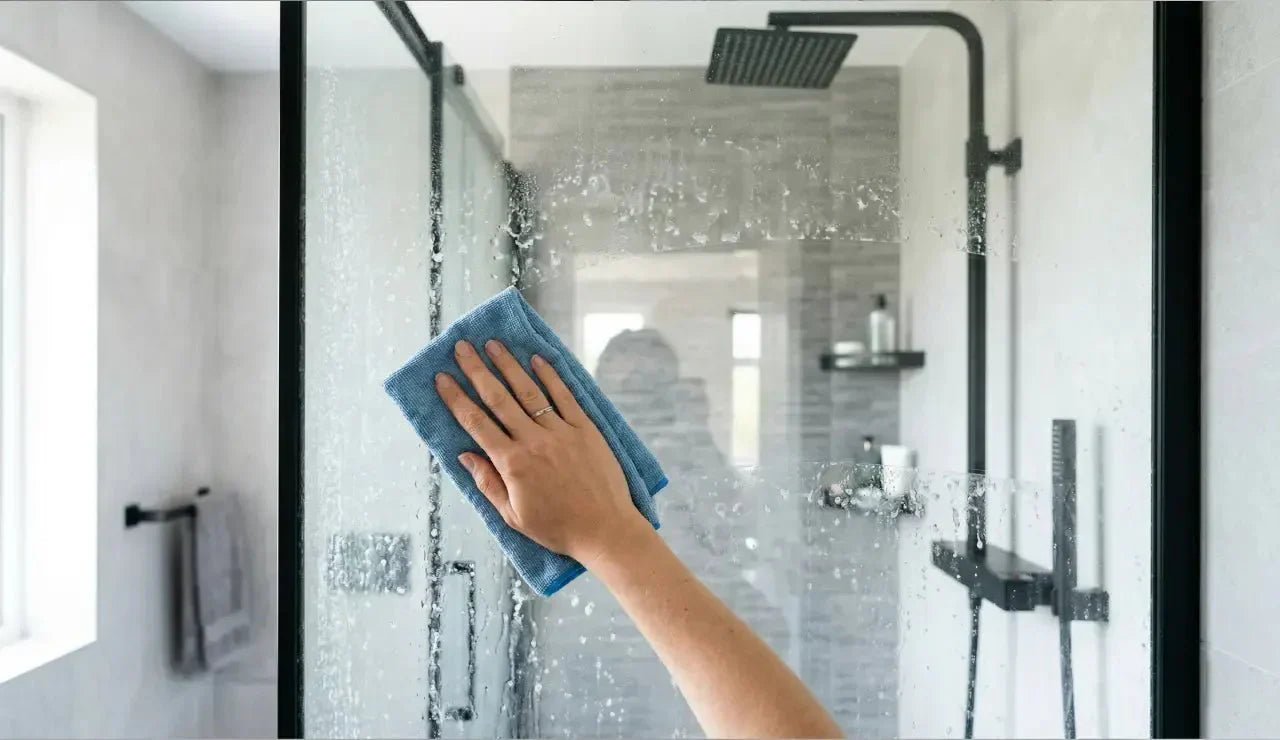
In short: to remove limescale from the shower the most effective remedies are citric acid (150 g in 1 liter of lukewarm water), diluted white vinegar, and baking soda and lemon paste. Spray, leave to act for 10-20 minutes, and rinse. To prevent it at the root, dry the glass after use and evaluate a water softener to reduce water hardness.
Removing limescale from the shower is a daily challenge that goes far beyond simple appearance. In Italy, water hardness — that is, the high concentration of calcium and magnesium ions — is the main cause of mineral deposit formation that can compromise not only glass transparency, but also the efficiency of shower heads and taps. If neglected, these deposits stratify, becoming a site for bacterial growth and mold.
The presence of limescale in the shower is a very common problem, because it is directly connected to the use of water.
If your shower a few hours after use has dull walls and an annoying whitish haze, it will surely be the fault of the accumulation of a large amount of limescale. Water, which contains large amounts of calcium and magnesium ions, when it reaches a very high temperature releases minerals that deposit on surfaces in the form of limescale.
Before understanding how to eliminate limescale from the shower in a fast and economical way, let's analyze what the causes of a large accumulation could be.
Presence of limescale in the shower: the causes
The greatest cause of the presence of limescale in the shower is due to water.
The shower surface, being always in direct contact with water, over time tends to get covered with the classic white film that makes it dull.
Every time it is used, the enclosure fills with soap and water splashes that, if not dried, will lead to limescale formation.
Its excessive presence on the glass will make it lose its shine and will make it become completely dull.
An excellent prevention against excessive limescale formation is purchasing quality shower enclosures that feature an anti-limescale treatment on the glass.
Where buying a new enclosure is not necessary, let's see some practical, fast, and economical advice to clean shower surfaces, eliminating all hazes efficiently.
How to eliminate limescale in the shower
The most common remedy to remove limescale from the shower, whether it is located only on surfaces or also on the hand shower, is to use a good anti-limescale product.
However, this method is not always infallible. For this reason, before spending money on a product that will not give you the desired results, we recommend 3 natural methods that will help you remove limescale in the shower in a simple way and without causing damage to components.
Use baking soda to remove limescale
Baking soda has the property of basifying what it comes into contact with, so it turns out to be an excellent method to remove shower limescale.
You just need to combine half a glass of baking soda with 2 glasses of water and your magic potion against limescale will be ready. You can also consider adding a few drops of orange oil to the mixture to leave the surface scented.
The resulting mixture will serve to dip the sponge and pass it over the encrusted areas of the shower, such as the glass or tiles.
Be careful however with contact with steel because, since baking soda is an abrasive substance, it could ruin it.
Add lemon for a more effective mixture
For an even stronger mixture, you can add lemon. The baking soda and lemon should be mixed together to create a pasty mixture.
Equip yourself with a sponge and rub the mixture on the shower glass, leaving it to act for about 15 minutes, so as to give the limescale time to dissolve completely.
After that, rinse thoroughly, and you will see that the surface will result shiny.
Remove limescale in the shower with vinegar
Using white vinegar or apple cider vinegar to remove limescale from the shower or hand shower is one of the most well-known methods, as well as one of the most efficient.
Pour half the amount of vinegar and half the amount of water into a spray bottle and shake well.
Once ready, spray the mixture on the encrusted or dulled parts and you will have immediate results. White vinegar, unlike baking soda, is not an aggressive product, so you will not have to worry about avoiding certain types of surfaces.
Clean shower surfaces with rubbing alcohol
If the above remedies have not brought the desired results, you can use rubbing alcohol to remove shower limescale.
You just need to dip a cloth in alcohol and pass it over the limescale-encrusted surfaces to make them shine again.
Using alcohol is certainly the fastest and most practical remedy that allows you to get rid of limescale effectively and in very little time.
Why Citric Acid is the ultimate remedy against limescale in 2026
Although vinegar is the most well-known remedy, modern household chemistry suggests the use of citric acid as a superior solution for efficacy and safety. Unlike acetic acid, citric acid is odorless, is 53 times less polluting to groundwater, and is less aggressive on rubber shower gaskets.
| Surface | Recommended Remedy | Contact Time |
|---|---|---|
| Glass and Crystal | 15% Citric Acid Solution | 10-15 minutes |
| Tiles and Grout | Baking Soda and Lemon Paste | 20 minutes |
| Chrome Taps | Diluted vinegar or 5% Citric Acid | 5 minutes |
How to prepare the citric acid anti-limescale solution
For effective maintenance, dissolve 150 grams of anhydrous citric acid in 1 liter of lukewarm water (preferably distilled to avoid new residues). Pour the mixture into a spray bottle and apply it uniformly. For more stubborn encrustations, you can cover the area with plastic wrap to prevent the solution from evaporating too quickly.
How to prevent the appearance of limescale in the shower
Completely avoiding the appearance of limescale in the shower is practically impossible, as limescale is contained in the water used for washing. You can, however, put into practice preventive methods to limit its quantity. Let's see what they are.
Dry the glass after each use
Drying the glass of the shower with a piece of newspaper or using a squeegee will help you eliminate all remaining water residues that could generate more limescale in the shower. It is certainly not a definitive preventive method, but it will help you slow down its formation.
Install a water softener
Consider installing a water softener on your plumbing system. The descaler will make your water less hard and therefore less calcareous. This is a great method to protect not only the shower but the whole house from limescale formation and its corrosive effects.
How to tell if you really need it? Look at your water hardness, measured in French degrees (°f): up to 15 °f the water is soft, between 15 and 25 °f it is moderately hard, over 25 °f it is hard and limescale becomes a daily battle. This figure is published by your water supplier in the water quality report for your area; alternatively, test strips sold for a few euros are enough.
Above 25 °f, limescale does not just dull the shower: it encrusts washing machine and boiler heating elements (causing energy consumption to rise), clogs shower heads and mixers, and shortens the life of the entire system. In these cases, DIY treats the symptom, but the structural solution is treating the water at the source: ion-exchange water softeners (salt-based, cabinet-style) remove calcium and magnesium from all home water, while compact anti-limescale systems with cartridges or dosing protect single appliances like boilers and water heaters without invasive installations.
You can find both solutions — cabinet softeners, cartridge systems, and anti-limescale dosers — in the collection of water softeners and water treatment systems: with softened water, the remedies in this guide will be needed less and less often.
Now you have all the right tips to keep your shower always clean and shining.
Excessive presence of limescale can also lead to problems and water flow alterations. In that case, you just need to clean the shower head carefully to restore normal water flow.
Specific component maintenance guide
Each element of the shower requires targeted approaches to avoid permanent damage such as scratches or dulling.
Shiny Glass
Transparency depends on daily prevention. Discover how to eliminate every haze from glass.
Read the glass guide →Shower Head and Jets
If the jet is weak, free the nozzles with the bag technique without disassembling anything.
Free the shower head →Shiny Taps
Learn how to protect chrome finishes with nanotechnology barrier treatments.
Tap polishing →WARNING: If you own a marble or natural resin shower tray, absolutely avoid pure citric acid or vinegar, as they would corrode the stone. Consult our specific guide for resin shower trays.
FAQ: Frequently asked questions on limescale removal
How to remove very hard limescale encrusted for years?
For encrustations stratified over time, 20% citric acid is the most effective solution. Apply the warm solution and cover the areas with plastic wrap to prevent the product from drying: leave it to act for at least 60 minutes before scrubbing with a non-abrasive sponge.
What dissolves limescale immediately? Which is the most powerful?
At a chemical level, strong acids dissolve limescale by immediate reaction. Citric acid is the best compromise between power and safety. If you are looking for a commercial product, specific professional detergents (such as Viakal or Sani-Kal) offer maximum immediate descaling efficacy compared to home remedies.
How long does vinegar take to dissolve limescale?
White vinegar requires prolonged contact times: from 20-30 minutes for light stains up to a whole night for deep encrustations (such as for tap filters or shower heads). Remember that vinegar can be aggressive on gaskets in the long run.
How to clean a shower enclosure encrusted with a lot of limescale?
The best technique consists in combining chemical action with mechanical action: use a baking soda and vinegar paste to lift encrustations and finish with a steam cleaner. Steam dissolves mineral bonds even in the most difficult corners.
Does muriatic acid dissolve limescale? Is it recommended?
Yes, muriatic acid dissolves limescale but it is strongly discouraged for daily shower cleaning. It is extremely corrosive to chrome taps, harmful to the environment, and dangerous for respiratory tracts if used in enclosed spaces.
Does a water softener really eliminate limescale in the shower?
Yes: an ion-exchange water softener removes calcium and magnesium from all home water, so limescale stops forming at the source, on the shower as well as on boilers and appliances. It is the definitive solution when hardness exceeds 25 °f; to protect only single appliances, there are also compact anti-limescale cartridge or dosing systems.


