

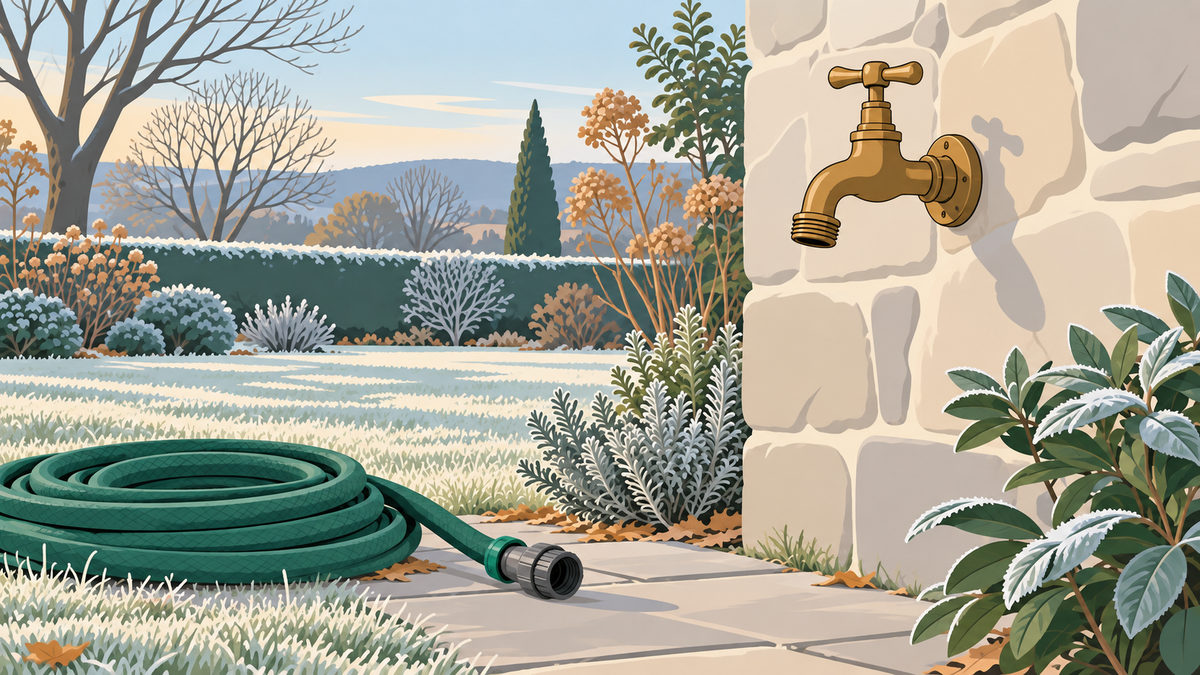
Your garden or balcony tap deserves a check before the first frosts. A hose left connected, a drain that does not work or an exposed tap can become a problem over winter.
To protect outdoor taps from frost, start with two questions: what type of tap do you have, and how is it supplied? A conventional model and one designed to drain after use need different care. The manual and your installer’s advice help you choose the right procedure.
Check your outdoor tap before cold weather arrives
Do not wait for a fixed calendar date: check local forecasts and inspect the accessories before the first frosts expected in your area.
Look at the tap and any visible pipework. Are there drips, damp joints or parts that are already damaged? Note what you see and have leaks checked. Also identify the model and find its winter use instructions.
If you do not know your plumbing layout, ask your installer to show you any valve dedicated to the outdoor supply and its drain point. Knowing where they are is more useful than trying to close valves at random once cold weather has arrived.
Disconnect and store watering accessories
When you stop watering, follow the accessories’ instructions: disconnect the hose, let the water inside it drain and store the hose, spray nozzle and sprinklers in a dry place, with the frost protection specified by their manufacturer.
Watering timers and hose reels may also have specific winter instructions. Check them before leaving equipment fitted outdoors. If a connection is difficult to remove, have it checked without forcing the tap or pipework.
For accessories you need to replace, you can browse the HDcasa gardening section, checking dimensions, connections and intended use. Preparing for winter still depends on each component’s instructions.
Isolate and drain only the outdoor line your system allows
There is no single draining sequence for every home. If your plumbing has a separate valve for the outdoor supply line and an accessible drain point, follow the procedure given in the manual or by your installer.
Opening the outdoor tap alone does not prove that all the water has left the pipe: you need to know the layout to establish whether that section drains.
If you cannot identify the valve with certainty, there is no usable drain point or the line also supplies other outlets, have a professional prepare the outdoor supply. Do not improvise changes to your home’s main water supply or heating circuit for this maintenance.
Even a frost-proof tap needs its own instructions
Some outdoor taps are designed to drain water after they are closed. Their operation still depends on the model and correct installation: the description “frost-proof” does not replace the instructions.
For example, on the standard draining taps described by Woodford, leaving a hose connected can prevent drainage. The manufacturer requires you to remove it when there is a risk of freezing. Check this requirement in your own tap’s manual, without extending the same procedure to every model.
The same applies to a hose described as “frost-resistant”: the product name alone does not prove that the water inside it will remain liquid. Do not use it as an alternative to preparing the plumbing for winter.
Check which protection is suitable
For a conventional tap or exposed pipework, ask a professional which insulating protection is compatible with the installation. Do not choose a cover based only on its shape: it needs to suit the component and the way it operates.
If the tap drains automatically, check that an accessory does not prevent it from working. A cover will not resolve an obstructed drain or an installation that traps water. Check these conditions before relying on external protection.
If you suspect ice or find a leak
If the flow is very low or absent after a frost, avoid forcing the handle. Do not try to thaw the tap or pipes with flames, boiling water or intense heat sources. Have a plumber assess the situation; if the problem involves the water meter, contact your water supplier.
Water flowing again is not enough to rule out damage. A leak may become visible as the ice melts or when you use the outdoor tap again. If you see drips or water on the wall, stop using it and ask for help before reconnecting accessories.
Your checklist before winter
Before frost arrives, check that you have:
- identified the tap model and its instructions;
- checked for leaks and visibly damaged parts;
- disconnected and stored accessories according to their manuals;
- confirmed how to drain only the outdoor supply line, where the system allows it;
- clarified with a professional how to protect exposed components.


