
Toilet encrustations are among the most unsightly marks that can affect one's home. A yellowed toilet bowl is something that can cause quite a few problems both at
an aesthetic and a cleaning level.
The bathroom is in fact one of the rooms at highest risk due to the accumulation of germs and bacteria, and for this reason its cleaning needs special attention.
Not cleaning one's bathroom even for a few days could cause those annoying and unsightly yellow stains to appear in no time, which will make even a new bathroom unpleasant and could lead to making a bad impression with our guests.
But do not fear!
Today we will see together how to clean toilet encrustations and how to deal with daily cleaning.
How often to wash the toilet to avoid encrustations?
Avoiding toilet encrustations is much simpler than one might think. The trick lies in understanding how best to clean the toilet and creating a well-consolidated routine.
In fact, for the care of one's toilet it is important to take into consideration two types of cleaning that we will have to do.
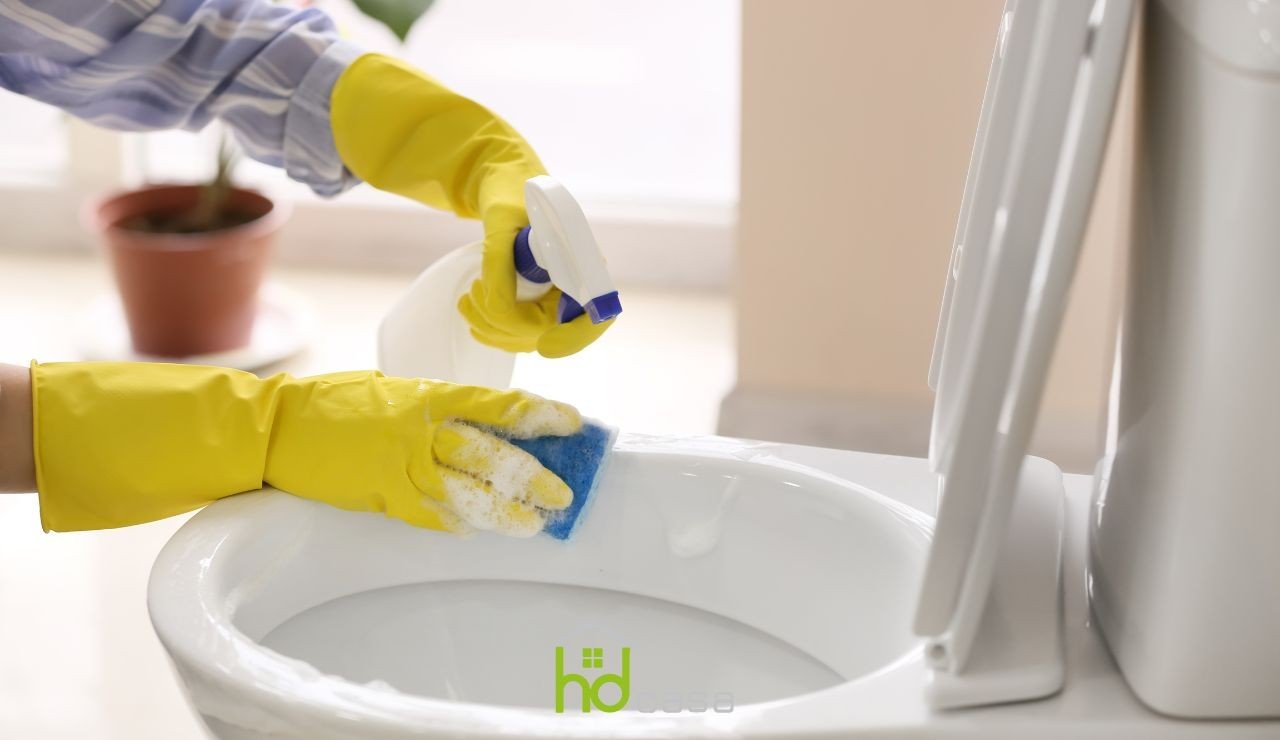
- Ordinary toilet cleaning: Clean your toilet every day with the right products. Use ordinary toilet cleaners that can be found on the market. For cleaning external parts you can use either the same cleaner or cleaning wipes.
- Deep cleaning: Clean the toilet thoroughly at least once a week. If, on the other hand, the bathroom is used by more than two people you will need to clean it between 3 and 4 times a week to avoid encrustations.
Applying these simple measures will allow avoiding limescale formation, both for sanitary ware and for bathroom washbasins.
Now that you have seen how often to wash the toilet let's see together how to perform a deep clean and definitively eliminate limescale and encrustations.
How to clean an encrusted toilet effortlessly
We have seen how often to wash the toilet to prevent encrustations from forming that force us to use "strong methods".
Instead, in case yellow stains have already appeared or a limescale encrustation has formed, do not fear!
Let's see together how to clean the encrusted toilet and recover its shine and surfaces without ruining them.
Use specific cleaners to clean your toilet
Let's see together which cleaners available on the market are most suitable for cleaning the toilet thoroughly.
- Simple bleach: It is one of the classic and effective methods. Apply bleach to the yellowed stains and spread it adequately. Leave it to act for a few hours and then flush the toilet to clean up.
- Anti-limescale liquid: To make the most of this product spray the anti-limescale cleaner on all bathroom surfaces and leave it to act for 5 minutes. Afterwards, flush the toilet until all anti-limescale residues have disappeared.
- Anti-limescale liquid and bleach: If you are not satisfied with the quality of white obtained only with the anti-limescale cleaner, you can use bleach and cover all previously cleaned areas of the toilet. After leaving it to act for about 20 minutes, flush the toilet until all bleach residues have disappeared.
- Muriatic acid: This liquid must be used with maximum caution. Pour the contents into the toilet and leave it to act all night. To have a better effect use the muriatic acid found in hardware stores and always wear gloves and eye protection to avoid dangerous splashes.
- Ammonia: This is an excellent product that can be used in conjunction with coarse salt. Create a mixture in equal parts and leave it to act on the encrustations for an entire night. The next day use the toilet brush to act on the stains and then rinse by flushing the toilet.
Repeat the operation for multiple nights if it does not work immediately.
We have seen what the best types of products on the market are for cleaning encrustations.
If, on the other hand, you wish to use natural products with a low ecological impact, there are many effective and economical alternatives that can be used.
Let's see them together in the next paragraph.
Descaling the toilet from limescale with natural and economical methods
There are several alternatives on the market that can be just as effective without, however, releasing harmful substances into the environment.
Let's see some alternatives together:
Salt, baking soda, and vinegar
This mixture is phenomenal against those unsightly yellow stains or dark streaks that are created with limescale.
- Create a mixture of salt and baking soda in equal measures and entirely cover the walls of the bowl and the drain. Leave to act for a few hours or, if you can, all night.
- Afterwards pour in vinegar, better if mixed with hot water.
- Use the toilet brush to scrub the toilet walls and remove the stains
- Flush the toilet until all residues disappear
Borax
Borax is a product widely used for house cleaning and beyond. To remove toilet encrustations it is possible to use it in different combinations:
- Borax and lemon juice: Create a mixture in equal parts, you will obtain a paste to spread on areas encrusted with limescale. After leaving it to act for a few hours, scrub with the sponge and rinse.
- Borax and vinegar: First, cover the affected areas with borax powder, then spray half a glass of vinegar and leave to act for a few hours or all night.
Citric Acid
Citric acid represents a natural and economical alternative for cleaning encrustations.
- Create a mixture made of 1 liter of water combined with 50 grams of citric acid.
- Sprinkle the area using a spray bottle and finally scrub and rinse using the toilet brush.
The longer you leave the mixture to act before scrubbing it, the greater the degreasing effect will be.
How to prevent the formation of toilet encrustations
After managing to clean the encrusted toilet, it will be necessary to avoid the formation of further limescale that could bring you back to square one.
But what to do to avoid limescale formation?
- Anti-limescale filter: Water hardness can be really disabling and create quite a few problems. For this reason it is important to install an anti-limescale filter that can avoid encrustations and further problems. An alternative to the filter is the use of a water softener.
- Microfiber cloth: Use a microfiber cloth to clean surfaces and prevent water residues from accumulating. In this way you will avoid the formation of encrustations
- Lemon: Use this product at the end of your cleaning. You can either scrub the surface or use a mixture of lemon and water to clean the walls of the toilet.
Putting these small measures into practice will allow you to always best maintain the health of your bathroom, not only for sanitary ware but also to remove shower limescale and always have a clean and shining bathroom.


